

Fast and fail-safe Internet connectivity

Introduction

In many industry sectors a fast and reliable Internet connection is nowadays a resource critical for day-to-day business. Network usage patterns are as various as the requirements for the access method – voice over IP telephony needs low-latency connections, streaming video and file transfers require large bandwidth, and many business-critical processes demand the highest availability rate achievable with the respective access method.

This multitude of growing and continually changing requirements currently gets a cold reception by a small and inflexible range of products for business Internet connectivity. Cheap consumer solutions like one single ADSL line are rarely sufficient: A common availability rate of 97% per year, equivalent to over 250 hours of yearly downtime, disqualifies them as a viable solution in the business world.

Access products aimed at companies used to be based on dedicated leased lines which could achieve acceptable availability rates in combination with a backup line. The running costs for that solution remain prohibitive, however: Lack of competition leads to prices often more than an order of magnitude above consumer products with comparable bandwidth.

The middle ground is covered by SDSL-based business products with a typical up- and downstream rate of 2Mbit/s. Their uptime availability rate of 98% though is hardly better than ADSL consumer lines in terms of reliability. Usually backup lines are employed here as well, causing additional costs. Still: Thanks to competition in the marketplace, SDSL products are widely available at a very cheap rate.

But what if an application needs more than 2Mbit/s upstream capacity? Or in addition to that 30Mbit/s downstream is required? What about business critical applications, where every outage leads to unacceptable standstill in operations? Or branch offices without any DSL products available to them?

Situations like these and many others used to pose a problem nearly impossible to solve. With the Multichannel VPN Router this is now a thing of the past.

The solution: Bundling several broadband lines

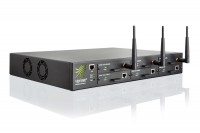
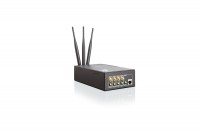
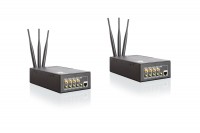
The Viprinet Multichannel VPN Router enables you to use up to six internet access lines in a bundled form. The novel bundling technology developed by Viprinet can combine arbitrary access products . All connected lines appear together towards the LAN as one „thick line“. Single lines going down only cause a reduction in available bandwidth. By distributing the failure risk across several access providers, a total availability of over 99.99% can easily be achieved.

Using the Multichannel VPN Router even the most demanding requirements for business Internet connectivity can be met. ADSL and SDSL products can be mixed and matched according to bandwidth needs – for example two ADSL2+ lines with each 16Mbit/s downstream and 1Mbit/s upstream can be combined with one SDSL line with 2Mbit/s synchronous bandwidth to get a total bandwidth capacity of 34Mbit/s downstream and 4Mbit/s upstream.
If downtime needs to be as low as possible, high-availability network connectivity can be achieved by combining different Internet providers and access methods. For example, DSL-based lines can be combined with UMTS connections – even when DSL equipment in the switching center should malfunction, the network stays up via UMTS. At sites where DSL is not available, several UMTS connections can be bundled as an alternative – this is also an ideal broadband access solution where location changes frequently (expositions, broadcast vans).

Practical realization

The access lines connected to the Multichannel VPN Router are not directly utilized for data transmissions. Instead an encrypted VPN tunnel to a peer (the so-called “VPN Hub”) located at an Internet backbone is established for each currently available line. These encrypted tunnels are then internally bundled by the router and appear towards the LAN as one single line. The VPN Hub then decrypts and correctly reassembles the data streams and forwards them to their original destination in the Internet.

This technology not only makes it possible for one single download to use all lines simultaneously, the router can also retransmit packets lost due to a failing line using the remaining lines. This way, lines going down do not cause any connection aborts – even 24h disconnects common with ADSL lines cannot be noticed anymore.

IP addresses provided by the physical line providers do not get used in the LAN anymore – they are completely transparent and shielded. Instead an arbitrary number of IP networks can be routed from the VPN Hub to the respective site. This way, many services that need to be publicly available (e.g. mail servers or tele-work software) can be run inside the company network. This also makes the local site independent of provider IP address assignments, so you do not depend on long contract periods and can always use the most economic Internet lines available.

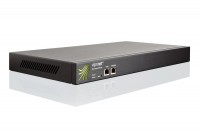
In order for the Multichannel VPN Router bundling technology to provide offices with a flexible, fast and reliable Internet connection, it needs a peer in the form of another Multichannel VPN Router with a reliable and secure connection to an Internet backbone.

Companies from e.g. the IT industry that already have space in a data center at their disposal can operate this peer under their own authority. The VPN Hub is simply mounted in a rack alongside existing server hardware.

Another alternative is to rent a peer – a service offered by Viprinet, its affiliates and others. Here the VPN Hub is deployed directly at an Internet backbone in a data center complying with the strictest standards for monitoring and physical security. The customer can still freely choose which lines to use at their site.

Even though the requirement of a peer does pose a certain initial overhead, the advantages prevail in practice. The way is also paved for future network expansions: One single VPN Hub can simultaneously serve many branch offices and field workers, and a fully-fledged VPN spanning across further branches including home offices is only a small step away. Further information on the extended possibilities when using the VPN Router for site interconnection is available in our solution overview „VPN branch interconnection“.

We would love to work with you and our partners to deliver you custom-tailored network connectivity. Contact us!